The pitfalls of mixing first-person and third-person narratives

SCBWI
Last month at the SCBWI (Society of Children’s Book Writers and Illustrators) Western Washington monthly meeting we heard a very interesting talk on plot and pacing from Elana Roth, agent with Caren Johnson Literary Agency. I got a lot out of Elana’s talk that I would like to share, but her first point was that we restrain from blogging about the specifics of her talk. Let me say only, that if you have a chance to hear or read her comments, please do.

During the Q & A I asked her a specific question about the book I’m currently working on:  Is it okay to mix first and third person narratives.  Her answer shocked me.

No!

What I’m writing is a crime/sci-fi novel for middle graders, with a heavy emphasis on the crime genre.  It’s nearly noir for kids.  In order to make it interesting I must write scenes out of the protagonists POV.  The technique gives the Harry Potter novels much of their tension.  The reader feels a doubling of urgency when the villains are on stage, as it were.

My first draft was written in the third person and was pretty good.  The major problem was that it was difficult for me to give authenticity to the main character, an eleven-year-old girl, while staying in the third person.  So, I studied books that use the first person to create a more vibrant character (The Postcard by Tony Abbott, for one).  Then I rewrote the novel, making the main character’s POV first person.

The story was definitely improved by my being able to give my character an inner voice.  She could not only comment directly to the reader, but in a real, humorous and appropriate way. But I was troubled by the mixing of the first and third person narratives.

Alana was adamant in her opinion.  It just doesn’t work, she said, and you won’t find good examples of it – unless the mixing was very organized and predictable.  That wouldn’t work for my book.

I relented and returned to the third person.  I did keep many of the access points by using the classic “she thought” technique.  In doing so, I believe I’ve improved my access to the character, and so my telling of the tale.  I do want to thank Alana Roth for helping me through this.  I might have made a serious misstep had I – not only heard – but taken her advice to heart.

A passage on a tall ship

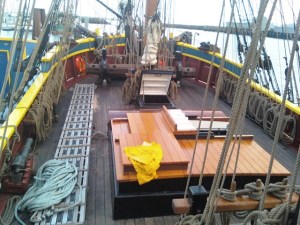
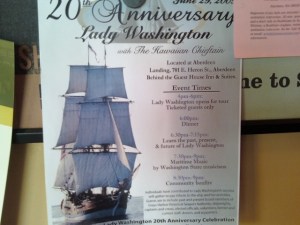
Lady Washington Passage HalfTomorrow, my friend Tom Ormbrek and I are sailing an eighty-mile passage from Ilwaco, Washington at the mouth of the Columbia River to Westport, Washington at the mouth of Grays Harbor.  We’ll leave at three in the afternoon and arrive at seven in the morning. Or nine, or noon depending on the wind and the seas.

We will sail on The Lady Washington, the official ship of the State of Washington.  It also happens to be the ship used in The Pirates of the Caribbeanand and many other films.  Johnny Depp, Keira Knightley and Orlando Bloom stood upon it many a time.

Tom is a good friend and a very astute fellow from a lively, intelligent family.  His brother knows everything there is to know about old films.  And his other siblings are equally interesting.  His niece Layla is a writer.  His mother Virginia is wonderful women of about ninety who remembers much more than I’ve forgotten.    Tom is a tin bender, as he describes himself.  He’s a union man, making his living creating parts for Boeing aircraft.  And an expert on Northwest and general  American history, Mark Twain, the gold rush, etc.  Tom eschews commercial television in favor of PBS and C-SPAN.  And he plays a wicked harmonica.

I am going to see what life was like on a two-hundred year old ship.  The Lady Washington is a replica of one by the same name that sailed the Pacific long ago.  I want to sail on the closest thing I can to a real pirate ship as background for a children’s novel I am currently writing.

I’ll try to post from the trip, if technology allows.

So, yar!

Time Travel and Mythology

Dream City Today

Creating backstory for a novelist is a challenge. Creating backstory for a tale about travelling back in time to the origins of a city of one’s own invention requires a bit more effort.

The Timearang Pirates, the working title of the second novel in my current series The Inventors Daughter , is such a story. I don’t want to give too much away, so let’s suffice it to say that Erin Isabelle, my eleven-year-old protagonist, goes back three hundred years – to the founding of the city – to fix something broken in time.

Fortunately, I had laid a few breadcrumbs in the first novel. In The Inventors’ Daughter I more or less felt my way through the story with my eyes closed, for I didn’t know the characters or the setting. I just knew it would be a fantasy novel for kids.

The characters came quickly. I started with a clever, sensible girl who keeps her inventor parents from wrecking their city with their creations. Their being professors required teachers, students and deans. As there was an invention to finance, I needed a financier. Being a crime story necessitated criminals and someone (a reformed wicked uncle perhaps) to help my hero catch them. Bingo, I had a deck chairs filled with characters.

Setting was another matter. Having originally placed the tale in New York, I found myself struggling with its geography. I went to college there for eighteen months, so I knew the city reasonably well. But I was warned by others that I should be very accurate lest those who knew the city much better – like the majority of people in the publishing industry – would be put off by my likely gaffs. I mentioned this to my professor at the University of Washington. Without looking up from her work, she flicked her hand dismissively and said, “Make up your own city.”

Everything changed from that moment forward.

The city became Dream City. It was an appropriate name for of noir story. This was a book that many kids would read at night before they went to sleep. “The City of Dreams,” would be the motto of the city. Central Park became Morpheus Park, named after the son of the god of dreams. Gods made me think of the 18th and 19th centuries founders of the city whose education would have been steeped in Greek and Roman mythology. It was also an era of scientific curiosity and very dark nights in which to study the heavens.

Astromomy is the study of stars and planets, so why not have references to them in the city itself? Like New York, Dream City would be a grid of north-south avenues and east-west streets. So, I named the avenues after the planets and constallations; the streets, after stars (with some exceptions for historical purposes).

Most significantly, being a world of my own invention, I could place Dream City wherever I wished. I chose to build it across three islands a foggy mile off an unnamed continent. I made the shapes of the islands astronomical: Star, Moon and Comet – all of which were created from a circle, the negative parts of which were submerged. I made up a native legend about how they fell from the sky. To keep the references in the city straight, I created three maps. One from the discovery of the islands by Europeans ( Pirate Map ), a modern map on the same scale ( Modern Map) and a detail of the central island ( Modern Map Detail) .

Now, before jumping into the second novel, I must create the details of the founding of the city. For it is into that moment that an interloper has leapt, disturbing the future for Erin, her inventor parents and The City of Dreams.