Lady Washington docked in Ilwaco, WA. [Post from cell phone.]
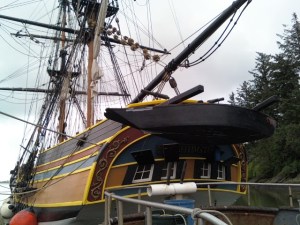
Lady Washington docked in Ilwaco, WA. [Post from cell phone.]
Sailing delayed until first light Friday. Will sleep onboard tonight in port.
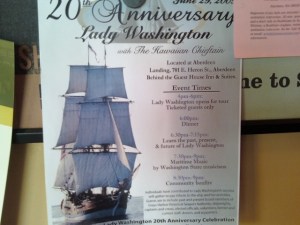
 Tomorrow, my friend Tom Ormbrek and I are sailing an eighty-mile passage from Ilwaco, Washington at the mouth of the Columbia River to Westport, Washington at the mouth of Grays Harbor. We’ll leave at three in the afternoon and arrive at seven in the morning. Or nine, or noon depending on the wind and the seas.
We will sail on The Lady Washington, the official ship of the State of Washington. It also happens to be the ship used in The Pirates of the Caribbeanand and many other films. Johnny Depp, Keira Knightley and Orlando Bloom stood upon it many a time.
Tom is a good friend and a very astute fellow from a lively, intelligent family. His brother knows everything there is to know about old films. And his other siblings are equally interesting. His niece Layla is a writer. His mother Virginia is wonderful women of about ninety who remembers much more than I’ve forgotten. Tom is a tin bender, as he describes himself. He’s a union man, making his living creating parts for Boeing aircraft. And an expert on Northwest and general American history, Mark Twain, the gold rush, etc. Tom eschews commercial television in favor of PBS and C-SPAN. And he plays a wicked harmonica.
I am going to see what life was like on a two-hundred year old ship. The Lady Washington is a replica of one by the same name that sailed the Pacific long ago. I want to sail on the closest thing I can to a real pirate ship as background for a children’s novel I am currently writing.
I’ll try to post from the trip, if technology allows.
So, yar!
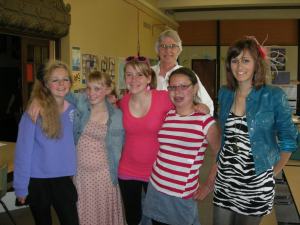
Eighth-grade Critique Group
This was the second round of criticism for these students. They read a very early version of The Inventors’ Daughter – so early, in fact, that it was called Erin Isabelle and the Wicked Uncle. All of those who read the first draft were invited by their teacher Brian to read the second. I don’t know if one can draw a strong conclusion from this, but only girls volunteered to critique the rewrite.
As you can tell from the photograph, they are a wonderful and spirited group, and they were very generous in their opinions and support. Though their comments were somewhat more detailed, they agreed with the assessment of the fifth-grade group entirely. (See next post above.) Those points were exactly what I was looking for. I tend to ignore a single person’s comments, unless they resonate with my own feelings. But I take the unanimous enthusiasm for the work and the pinpoint critiques of sixteen middle-grade readers very seriously indeed.
One thing that inspired me about this group is how close they are. Obviously they know one another well after at least three years together, but there is something else. The very fact that they volunteered to re-read a manuscript demonstrates a shared intellectual curiosity and enthusiasm for exchanging ideas that is a credit to their school, their teacher and most especially to themselves.

I finished my outline for the new story today. It took me a couple of weeks, but I’m satisfied that writing it was a good idea.
I have mixed feelings, not about the outline itself, but about knowing so much about the plot. The less you know about your journey the more exciting it is. But, as any veteran traveller can tell you, there is a danger in not knowing what’s ahead.
There are two good things about this outline:
Firstly, I won’t end up retreating from blind alleys having forgotten important aspects that must be brought forward. No stranger to this behavior, I’ve spent many days reworking the messes I’ve gotten myself into.
Secondly, with plot in hand, I can concentrate on the richer characters that a solid story can support. Hopefully I will be able delve deeper into the circumstance, behavior and dialog of each. Laborious and difficult as a writing an outline can be, these three-thousand words may save this writer the frustration and indignation of the dreaded page-one rewrite.
 To name someone or something in literature is to give it breath. To write “The woman in the white suit” is one thing. To write “Emily Johnston, the woman in the white suit” is quite another. A woman is a part of the plot. Emily is part of the story. Both may have lines, but only Emily is likely to have a history, even if it’s a brief one.
The names themselves are often important. A name is the first gift a person receives. They are intentional labels that speak of the culture and the temperament and aspirations of the family. Emily is tender. Paul is strong. Elizabeth is nobel. Names evoke the spirit of another. Nicknames are given to and usually accepted by people whose qualities are representative of their qualities – unless they are ironic, like a “Shorty” for a tall man.
For writers thought should be given before awards a name. The named person plumps a story and adds complexity. Emily has importance. A character too richly drawn may turn the reader’s eye from the main story. Too few characters can make the tale thinly drawn.
Success comes down to the writer’s craft. Hemingway did quite well with one character in “The Old Man and the Sea.” Dickens and Tolstoy used dozens with clear success. There is no right number. Just remember, writers, that a character is a guest in your work who must be provided for and attended to.
 Last week the outline to my new novel was a mare’s nest of plot threads. Or perhaps a bridge to nowhere would be a better metaphor. The SCBWI conference., notably Steven Malk’s talk, has energized me to do a better job.
One problem I’ve had historically with this process is my anxiety over the word outline. The term denotes an empty shape. A hollow thing. It connotes the tedious list my dreary teachers and professors forced me to write.
My process in this past week was to simplify and focus the plot. It was drowning in recursive complications. After ripping out the unwanted text, the storyline now has loads of room to roll out an organic sequence of events with believable character development.
Then I began to write, not a list, but a warm narrative of the action. Though I laid the plot points out in chronological order, I composed them from the edges toward the center, leaving open spaces to be filled in as a write the text itself. From this narrative I should be able to create a bulleted list to make even the most stern professor proud.
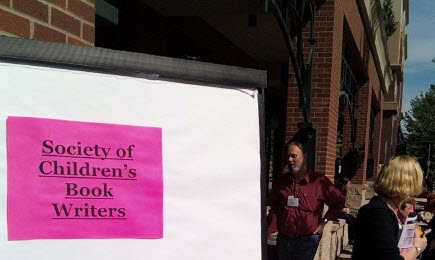 This weekend I’m attending the 18th Annual Writing and Illustrating for Children Conference in Redmond, WA (home of Microsoft).
This is an excellent SCBWI Washington event with over 400 attendees. The highlight for me is six breakout sessions on writing, editing and publishing. These are very helpful, as is the chance to meet editors, agents and a host of local and nationally known writers. Mostly, though I’m in it for what I can learn.
The weekend is beautiful. No rain. Sunny and 75. Seattle really is one of the best places to be in the world in the summer.
 I’ve learned a great deal about writing from reading. You are what you read. Everyone says it. Stephen King in his On Writing, for one. John Lennon became the songwriter he was by listening to stacks and stacks of pop 45’s.
And yet, good writing doesn’t just come from reading, nor education by itself. Satisfactory writing, for me at least, comes through quite a lot of unsatisfactory writing. It’s easy to beat yourself up about it. Indeed, I’ve gone to the school of self-flagellation wearing my sack cloth and ashes. By in large, that time was wasted. Vanity and modesty are both illusory.
Good writing comes in the effort of making your imagination clear. Clarity informs everything. It tells you what is overstated, ommited and overdramatized. To be clear is to tell a tale or sing a song without deviation, and isn’t that what we all look for in art?
And patience can’t be underestimated, for it implies two qualities one brings to a piece: First, the dignity of labor. To be patient means you will show up on time with a willingness to work for as long as it takes. Patience further suggests that you will leave your negative nature behind and not infect the words with it.
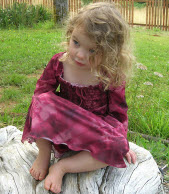
The photograph, by the way, is of my granddaughter Erin who at three-years-old exhibits a remarkable degree of clarity and patience in so much that she does – especially her storytelling. As an example when she was barely two, she created an imaginary sister named Wall. Her hands and feet are mermaids and such. Each has a name and a set of traits. She has stories about them all, and talks to them regularly. The remarkable thing is how clearly she remembers each vignette and how consistent are the properties of each character. I know this because when I confuse them, she corrects me with an all but imperciptible show of exasperation. She is my inspiration.
Here is a quote from The Inventors’ Daughter series website in which I describe my collaboration with famed Dream City writer S. E. Hunt. (S. E. is a very close relation. In fact we could hardly be closer.)
Every night – very, very late – I fly high above the clouded moonlit ocean from Seattle to Dream City, never quite sure whether Professor Spotworth’s buzzing, sputtering Astral Phaeton will stay aloft for the entire frigid, buffeted journey. Once there, I join S. E. in a gloomy, back-alley coffee shop where we scribble, shout and toss notes at one another from opposite ends of a long, battered table.
http://www.theinventorsdaughter.com/Author.aspx
Why have a collaborator? Don’t get me wrong. I’m used to working alone, and I tried my best to research Dream City and write the book by myself. I was shown the shark-shaped Aquarium. I joined the Jupiter Space Museum, a five-story glass ball resembling the striped planet with the hurricane-eye riding on its equator. I even travailed up to the Tripod observation deck where I could look down seven-hundred feet onto the three Dream Islands below.
But it was no use. I could tell the stories alright, but the pages were as dry as a Pharaoh’s mummy. No, I needed a partner who was not only a good writer, but a resident of Dream City and someone who actually knew the brave and clever Erin Isabelle Becker-Spotsworth. I believe our collaboration, though quite stormy, has yielded far richer tales than I myself could have ever told alone, or he by himself for that matter.
I recommend to all writers that they occassionally take the opportunity to join a fellow scribbler and see if one plus one does not equal … well, who knows what?
I suppose not knowing is rather the point, wouldn’t you say?
The Inventors’ Daughter series is filled with real and imagined characters. Many of those in the first book are drawn from people I know.
The phenomenon is something like people from Kansas appearing in the Land of Oz. My Dr. Cadeus Vulpine, for instance, is a shifty version of my friends Bret and Roy. Both are witty, articulate and precise men who are great fun to talk to. Both are race car drivers coincidentally. Saffron Chilliwack is an expansive, fulminating and bracing woman not unlike my writer friend Joy Laughter. (Yes, that is her real name.) Hildegard Becker (Mom) is a concoction of my aritist mother, a pinch of my sisters and a sprinkle of my friend Hilary, a very nice, real-life scientist.

Dad and Uncle Charles, the two brothers in The Inventors’ Daughter, were created from a pair of real brothers. The men have been estranged since their turbulent adolescence when the older brother broke with his father and lived among the winds. Like Charles, he coiled himself in the mystique of music. For decades he lived in Charleston and New Orleans composing and performing in night clubs and on the streets. And like my Charles Spotsworth, he becomes conflicted by a vagabond’s need of the road and the yearning for intimacy that age laid upon him.
My Gerald Spotsworth character owes his nature to the younger of the real-life pair. Perhaps reacting to the tumult around him, he found comfort in the order of mathematics. Unlike his older brother, he went to college where he did very well indeed. He taught high school math, wrote educational books for children and programs for mathematical calculations for scientists. Later in life, he made a career of supporting large business computers. He too is a musician. I believe this musical thread precedes the brothers’ troubles, and I hope that someday it serves as a bridge to rebuild their relationship upon.
Let me say that I wasn’t aware I was writing about the brothers until the novel was over half-finished. I’m not sure the characters would have worked so well with the story if I tried to force the real events into it.
I suppose I was drawn to pick their story because I have an older brother who is a scientist. He and I are musicians as well. Except for a rough spot in adolescence when he and our father were very cross with one another, we were steady friends, and are to this day. We talk on the phone every week, and every year we get together for several days and reprise our old repetoire. You can see how powerful a family’s history can be.
My inspiration for the new novel The Timearang Pirates is a marvelous woman and her three daughters whose home is a boat they sail among the Pacific ports of North America. Did I mention my mother was an artist? I have not forgotten the many times she packed me, a paint box and an easel around the Western United States in a station wagon. More on that later.
It’s good to be me.
I’m currently in the middle of a ten day immersion vacation to plot out my new novel Timearang Pirates. I get up at 5:30 AM. By 6:15 I’m being served the world’s best double-tall split-shot Americano by Corrine or Precious at a cozy Fremont cafe on the shore of the ship canal a mile north of the Seattle Space Needle. I take my seat at my favorite table and work on my story until about 9:30, have some breakfast and go to the gym.
After a shower, I read source material before and at lunch. Next, I’m off to the library for two or three more hours of writing. A couple of late afternoons, I watched relevant films: Master and Commander and The New World. Around five o’clock I venture out for my last espresso of the day with my friends before returning home for dinner.
Quelle vie, non?


Creating backstory for a novelist is a challenge. Creating backstory for a tale about travelling back in time to the origins of a city of one’s own invention requires a bit more effort.
The Timearang Pirates, the working title of the second novel in my current series The Inventors Daughter , is such a story. I don’t want to give too much away, so let’s suffice it to say that Erin Isabelle, my eleven-year-old protagonist, goes back three hundred years – to the founding of the city – to fix something broken in time.
Fortunately, I had laid a few breadcrumbs in the first novel. In The Inventors’ Daughter I more or less felt my way through the story with my eyes closed, for I didn’t know the characters or the setting. I just knew it would be a fantasy novel for kids.
The characters came quickly. I started with a clever, sensible girl who keeps her inventor parents from wrecking their city with their creations. Their being professors required teachers, students and deans. As there was an invention to finance, I needed a financier. Being a crime story necessitated criminals and someone (a reformed wicked uncle perhaps) to help my hero catch them. Bingo, I had a deck chairs filled with characters.
Setting was another matter. Having originally placed the tale in New York, I found myself struggling with its geography. I went to college there for eighteen months, so I knew the city reasonably well. But I was warned by others that I should be very accurate lest those who knew the city much better – like the majority of people in the publishing industry – would be put off by my likely gaffs. I mentioned this to my professor at the University of Washington. Without looking up from her work, she flicked her hand dismissively and said, “Make up your own city.”
Everything changed from that moment forward.
The city became Dream City. It was an appropriate name for of noir story. This was a book that many kids would read at night before they went to sleep. “The City of Dreams,” would be the motto of the city. Central Park became Morpheus Park, named after the son of the god of dreams. Gods made me think of the 18th and 19th centuries founders of the city whose education would have been steeped in Greek and Roman mythology. It was also an era of scientific curiosity and very dark nights in which to study the heavens.
Astromomy is the study of stars and planets, so why not have references to them in the city itself? Like New York, Dream City would be a grid of north-south avenues and east-west streets. So, I named the avenues after the planets and constallations; the streets, after stars (with some exceptions for historical purposes).
Most significantly, being a world of my own invention, I could place Dream City wherever I wished. I chose to build it across three islands a foggy mile off an unnamed continent. I made the shapes of the islands astronomical: Star, Moon and Comet – all of which were created from a circle, the negative parts of which were submerged. I made up a native legend about how they fell from the sky. To keep the references in the city straight, I created three maps. One from the discovery of the islands by Europeans ( Pirate Map ), a modern map on the same scale ( Modern Map) and a detail of the central island ( Modern Map Detail) .
Now, before jumping into the second novel, I must create the details of the founding of the city. For it is into that moment that an interloper has leapt, disturbing the future for Erin, her inventor parents and The City of Dreams.

Soon after completing the inital draft of The Inventors’ Daughter– my first children’s novel – I met a conscientious and amiable teacher named Brian Williamson. We bumped into one another where I meet most of my friends, in a coffee shop in my neighborhood. When I mentioned the manuscript, he asked if a segment of his fifth-grade class could read the book and give me their opinions. I was thrilled. Here was the perfect readers group for a book aimed at 9 to 12 year-olds.
Six weeks later Brian and his students ate our brown-bag lunches around a venerable, well-worn work table in the school’s art room. As you can see from the photo, the students were a fun, lively lot. But as the discussion of the book moved around the table, I could see that they were intelligent and focused as well. From some, the remarks flowed freely. A few needed a bit of encouragement from Brian. But in no time, they too were giving me valuable commentaries on what they found funny, exciting or confusing.
The gratifying thing for me and Brian was that all of the students read the entire manuscript judiciously. And from their comments, I’m certain that I got more from these bright kids than I would have received from a my own writers’ group, however well-meaning, who would have been trying to second-guess my actual audience.
Two comments stood out in particular:
One girl said twice – with deep sincerity – that “the story must flow.” Other’s nodded. It was then I realized that, having been accustomed to writing screenplays which are scenic in nature, I had not acquired the skill of writing the smooth, corherent monologue that is the narrative of a novel. Scripts are shocks of dialog and an sparce, choppy narrative written for a host of artistic and technical people searching for their own assignments detailed within its text. A novel is something else altogether.
My second revalation was that some things were unclear to my readers. In an effort to conceal the skeleton of the mystery on which my plot hangs, my story had murky spots. A rule I learned in the University of Washington literary fiction program is that you must never describe something as “indescribable.” It is the duty of the writer to describe a character’s perception of anything – even a phantom.
With those two gems, I returned to my story and did my best to polish the manuscript into something my audience could understand and enjoy. My special thanks to Mr. Williamson’s readers’ group.
 In preparation for writing Timearang Pirates* I’m doing research on the age of sail and the physics of time.
I’m reading Master and Commander for the dialect and vocabulary. Patrick O’Brian was a very good writer with a slavish devotion to naval history, architecture and customs. Though the period of his story is both two hundred years behind and a hundred years ahead of my story, still his work is invaluable to me.
I’ve recently finished Under the Black Flag, a comprehensive history of the Age of Pirates by David Cordingly. It is the pirate lover’s bible and is well thought of by everyone I meet who knows the subject well. (And believe me when I say I know a few pirates here in Seattle.)
I’ve just bought The Charting of the Oceans: Ten Centuries of Maritime Maps by Peter Whitfield from Sea Ocean Books, a wonderful bookstore on the north shore of Lake Union here in Seattle. For anyone looking for books relating to the sea I heartily recommend this source. The owner is fastidious in keeping his stacks jammed with well-tended books and, being a retired sailor, is extremely knowledgeable. The Charting of the Oceans presents dozens of handsome representations of historic charts and has much to say about the history of the documents. I believe they will help me as a primary source for cartography and navigation, though some of my settings are not actually found on your globe.
Sea Ocean Books
About a month ago I bought a 1939 edition of the Sea Scout Manual from Amazon.com. In the second novel my main character Erin Isabelle Becker-Spotsworth must know how to sail. In the first chapter I plan to have her and some of her friends learning to do so from Erin’s inventor father. They will sail through Comet Bay off Star Island in a sloop in a stiff wind, foretelling the adventures that await our protagonist under the canvas on the high seas in the Seventeenth Century. The Sea Scout manual is a bit dated but dated in the precise way I want. There is something 40’s and ’50s about the first book and this one too. In The Inventors’ Daughter there’s a pinch of Roger Rabbit and Sam Spade about some of the characters despite the modern inventions. The series is in its way noir. Despite Erin’s best efforts to fight crime and injustice, Dream City – past and present – is a dangerous world. The scout manual was a gateway to that era and a pitch-perfect primer for young sailors, as it is still today. If I’ve learned anything from my research it is that tradition is everthing on the sea.
In my research of time and time travel I am concurrently, I am reading A Briefer History of Time by (of course) Stephen Hawking (with Leonard Mlodinow). I’ve read several books on Einstein’s theories, quantum and string theory and the physics of time and space but none so elegant and intelligible as this. I recommend it to anyone who wishes to better understand relativity and other currently held theories of universal physics.
I have also recently read a number of children’s fantasy books including the Harry Potter series, Wave Traveller, Hugo Cabret, the Lemony Snicket novels, Harriet the Spy, and re-reading Treasure Island and my favorite sea story, The Odyssey, which though not a children’s book is a fabulous yarn that (to dangle a participle) I hope my story bears some infinitesimal resemblance to.
 Sperry Hunt: Texas-born Singer-Songwriter of Contemporary Folk Music