From the novel: Erin and Monique caulk the forecastle deck

[Note: two girls from the 21st century are under full sail on the pirate ship Velocity racing toward Sugar Bowl Island. The year is 1720.]

The hours crawled by. The work was very hard. The old rope was difficult to remove, and it was rough with crusted tar and splinters. Much of it had to be yanked out by both of the girls pulling as hard as they could together.  To add to their troubles, the sun soon beat on their backs causing them to sweat.  The girls’ knees suffered until Mr. Toofour, the black sailmaker, happened by and, without looking at the girls, dropped scraps of canvas for them to kneel on.

Perhaps the worst of it was that Mr. Rumple made it clear that, once they had received their orders and training, they were forbidden to talk. None of the crew could say anything that wasn’t necessary to their work – even then they spoke quietly in short bursts.  Erin wanted so much to talk to Monique about their plan, their progress, the dangers ahead and most especially how they felt. And unlike in Mr. Bingo’s class in Dream City, they couldn’t whisper or pass notes when they simply had to share passing thoughts.

In time though,  Erin realized the silence wasn’t silence at all. She was surrounded by sounds: The hiss of the sea against the hull. The groans of the masts and yards. The lines trembling and whipping in the wind. The whumps and flaps and snaps of the sails. And, from time to time, the calls and responses of the officers and men. That’s when she understood the ban on chatter.  The officers and men had to be heard when a ship or coast was sighted, or a man hurt or a line broke.

Working on the thirty-foot square forecastle deck, Erin and Monique were constantly shifting about to allow people to pass. The lines holding the triangular staysails in the very front of the ship had to be frequently adjusted by skilled, agile men climbing along the bowsprit like monkeys. All the while, two very young men in long but rather ragged coats stood at the most forward point of the ship sweeping their telescopes across the horizon, along the starboard quarter; the other across the larboard, as Mr. Rumple called it. The young men spoke to no one, not even each other.

[Here is a photo of caulking a replica tall ship deck.]
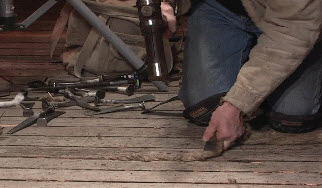
Caulking a tall ship deck today

The caulking material the man is laying between the boards is called oakum. It’s made from animal hair, worn rope or anything else fibrous. It was mixed with tar and driven into the gap with a blunt awl and a mallet called a beetle, a metal version of which is shown here.

Current Word Count 44,614

The Chaser and the Gig

The Chaser and the GigIn this photo are the chaser and the gig of the Lady Washington out at sea. The are NOT, as they would be to landsmen, a canon and a boat. They have different names to sailors.

Nearly everything has is different name at sea. The bathroom is the head. The floor is the deck. Walls are bulkheads. A stairway is a companionway. And people are often known by their title and their jobs rather than their names. A senior officer is addressed, Sir; a junior one, Mister. At least in the stories of 1720, the time period I’m currently writing about.

This blog entry is by way of explaining – at least to myself in this log – that there is an explanation why my story has progressed only slightly since my last entry. I have had to spend several weeks more than I already have in learning not just the parts of the ship, but the language of its inhabitants of three hundred years ago. I must say, it’s been more fun than work. Here are the books I’ve studied:

The 24-gun frigate Pandora by John McKay and Ron Coleman (2003)
The Reverse of the Medal by Patrick Obrian (1986)
Two Years Before the Mast by Richard Dana  (1840)
A General History of the Pyrates by Danial Defoe (1724)
Henry IV Part I by William Shakespeare (1597)

The first two are sources for nautical terminology and war at sea. The third is about the duties of the the sailors. The fourth is about the language of the 1720’s and the lives of pirates (written by the author Robinson Crusoe).  And the last for the flamboyance and immediacy I wished to breath into some of the characters. I’ve used my Nook Tablet to search these books. And the audio of the last for flavor.

Now I will resume once again – with better footing – to assemble those words forged long ago into a story yet to come. Hopefully at a faster pace now. I’m hoping to finish the draft by the end of summer.

And by the way, unlike the heaps of useless stuff we landlubbers surround ourselves with, nearly everything is vital on a ship of war. Though small by comparison to the cannons that provided broadsides, the little chasers bolted to the stern were used at the most desperate moment when an enemy came “under the stern,” as was the term. This was the moment when the foe could, in one shot, render the boat unable to maneuver by shooting the way it’s rudder which is just to the right and beneath the chaser. Without the rudder, the enemy could simply sail back and forth pouring fire into the bow and stern with impunity.

The importance of the boat, in that case, would be elevated as it was the only means of escape save death or surrender. That’s why before the action began, the men tied the boats together in a chain and pulled them into a battle well below the level of fire.

Current Word Count 43,266

Chapter 18 – The Race for Sugar Bowl Island

Erin’s eyes sprang open from a dream of counting. All was black save a flickering slice of yellow light. She was swaying. Something thumped on the roof. Something hissed against the walls. There were bells. Her mind was still counting them from the dream. Three bells … four bells … five bells.

The truth fell on her like a stone on her chest.  It was the middle of the night. The roof was a deck. The walls were a wooden hull slicing through the Deep Blue Sea. She was swinging in a hammock.  In the belly of a pirate ship scudding toward Sugar Bowl Island. To save another pirate ship from being blown to splinters. The year was 1720.

Erin was three hundred years from home.

Current Word Count: 42, 411

Weekend on the Water 2011

Weekend On The Water

I recently returned from a fabulous writers’ retreat at one of the most beautiful places in North America.
Where: Alderbrook Resort in Union, Washington at the southern shore of the Hood Canal.
Who: Given by the Society of Children’s Book Writers and Illustrators of Western Washington for fifty writers and illustrators.
The speakers were (and I quote from the website ):
“Arthur Levine, author, publisher of Arthur A. Levine Books, and a vice-president at Scholastic Inc., and Newbery Medal award-winning author Linda Sue Park.”

The weekend has been a life-changing experience for me.  Attending was  a selected group of dedicated and excited writers and illustrators. The atmosphere was friendly, positive and supportive. Jolie Stekly, Joni Sensel and Laurie Thompson and the rest of the staff from the SCBWI-WWA orchestrated everything perfectly.

And the speakers were wonderful.  Backing off the superlatives for a minute, Arthur really helped me understand the strengths and the weaknesses of the beginning of my manuscript.  Each of us sent him the first five pages of our story, plus a one-page synopsis.  He made a point of reading them and writing notes before he arrived. (Which was a feat considering the blackout he and the rest of the Mid-Atlantic had just been through.)  He said many kind things about the piece which I very much appreciated.  But even more important he gave me two ideas, I had considered but that my vanity had prevented me from embracing. Even then, I hesitated. What drove his points home, however, was the clever meeting format he chose. I got to listen to his critiques of twenty-four of my peers’ work, and I agreed with all of hs comments.  How could I possibly consider that his about mine was the only one that was wrong?

Linda Sue Park gave us hours of tips on the craft of writing. She is not just a Newberry Award winning author, but a true artist.  Without getting into the specifics, she uses many of the techniques that other artists use to explore and sharpen her pieces ways that are unique to each of them. Most importantly she taught us to challenge ourselves to write more originally.

Thanks to everyone.  I look forward to seeing the alumni from the conference at upcoming Puget Sound SCBWI events.

From Chapter Twelve of the new novel

As the girls entered the building, Erin was struck by the enormity of the lobby and everything in it.

The room was the size of Central Train Station. Forty-feet above the floor, the ceiling was a backlit blue-glass dome supported by thick brass arches. On each of the side walls hung a huge steel clock with giant brass gears that turned at various speeds. High on the wall ahead was mounted an enormous glass map of the world with brass continents. Blue neon tubes radiated from Xdom across the amber oceans to the great ports of the world. Beneath the map, was a steel-clad reception desk.  Behind it, a line of tall, powerfully built guards paced menacingly in their black suits. Their keen eyes shifted quickly amongst the visitors milling about the room and scattered among the chairs of the waiting area.

The room gave Erin a chill, which she believed was intentional. The high ceiling and the big men would naturally make the visitors feel small. Standing between the huge clocks gave the impression that the company’s time was more important than the minutes tracked by the visitors’ little watches. And the massive world map with its glowing tendrils spreading across the vast globe made the company seem like a planetary spider.

Erin drifted toward a placard marked “History of X Energy.” Perhaps it could tell them what had happened to their beautiful city. But before she reached it, she was stopped by Monique’s exclamation.

“Oh, my Gosh, it’s THEM!”

Erin turned back toward the reception counter where the guards stared back at the girls like hawks on a wire eyeing a couple of mice.

She turned her attention to two extraordinary men moving toward Monique and Erin.

Monique was right. It was THEM.

Current Word Count: 27,077

My favorite sailor

Me and my favorite sailor

This is me and my favorite sailor (and granddaughter) this summer. We were on a sail on the Hawaiian Chieftain, doing research for the book I’m writing.  The Chieftain and the Lady Washington battled that day with guns blazing. Everything was real except for the cannonballs. I’ve got to  say we took the worst of it.  Had she more than paper wading, The Lady would clearly have shot our anchor away leaving us at her mercy. Fortunately we lived to play another day.

It was indeed a glorious day, for me especially, as you can tell from the photo above.

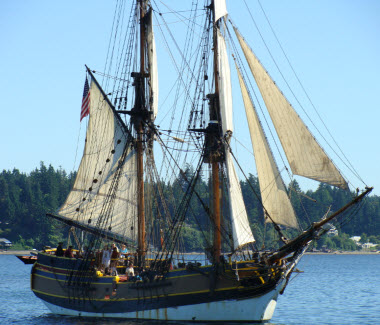
Here’s the dreaded enemy ship under full sail.  It’s the ship Johnny Depp was on in Pirates of the Caribbean.

The Dreaded Enemy Lady Washington

Changes to the plan

Sometimes you need to change the plan

I wrote a ten thousand word outline for the novel I’m working on. The benefits of such thorough planning cannot be exaggerated. Relative to the first book in the series which had no outline, I’m sailing through the story. Of course, knowing the situation and the characters well at the start of the second book has made writing an outline relatively easy.

Now, I’ve come to a spot where I need to alter the plan. One character talks another into doing something that seems out of character, and I have to find a motivation.Vanity was my first thought, since it is the universal motivator. The next step is to backfill the situations with the motivation.

It actually only took three small inserts to make the action believable. I snuck them into the outline for documentation purposes and am now massaging the changes into the text.

Voila.

Chapter Ten – Thieves in the Night

Thieves in the Night

Back to posting to this blog after our vacation to Santa Fe. Had a great time on very familiar ground.

Familiarity is one reason I go. As everything changes, we search for that which seems not to: old songs, old cars, old friends. I live two thousand miles from where I grew up. I go back to see if things have changed and of course they have.

But Santa Fe almost hasn’t. We were there for a fiesta that has been celebrated on the plaza for 299 years – since 1712! The plaza, the Governor’s Palace and the Plaza Hotel are the same. The tile on the hotel floor has the same luster it did in my childhood. The five and dime is half a block away – though it’s no longer Woolworth’s.

I visited Cow Creek, twelve miles of dirt roads beyond of Pecos NM, where a spent several summers with my boyhood friend George. The river is the same as are the road and the rocks. The trees – many scorched by a fire several years ago – are returning. It all lifts my heart.

And so does this children’s story I’m writing.  Twenty-thousand words so far.  I hope to finish it by Fiesta Santa Fe’s three-hundredth birthday, next fall.

From page 79

[This scene occurs in Mr. Bingo’s sixth grade class at the Princess Blue Leaf School for Girls in Dream City.]

As the girls took their seats, Monique asked, “Did you show Mr. Bingo the scrimshaw?”
Erin had written Monique in Paris about the ivory carving that had stuck to Dr. Griffin when he fell in the meteorite hole.

“Not yet,” Erin said.

“I thought you were going to -”
“Sh-h, Let’s talk about it later,” Erin said looking intently at Mr. Bingo as he stood before his class.

Erin hadn’t hushed Monique out of respect for her teacher.  She didn’t want to talk to him – or anybody else about the carving.  The scrimshaw might be valuable or historical, and they would take it away.

She liked the cool smoothness of the ivory and the picture of the girl who looked a little like her. Dr. Griffin had discovered the object and given it to her. When she took it, she knew it wasn’t really hers, or even his. But the ivory had spoken to her somehow, and it felt like hers now. She kept it in the darkness of her pocket and took it with her wherever she went.

Currently reading …

Books I'm Reading

Here are the two books I’m currently reading as I write the second book in The Inventors Daughter series.

”The Neddiad: How Neddie Took the Train, Went to Hollywood, and Saved Civilization by Daniel Pinkwater.
This one is for sheer fun and to glean something from the wonderful Pinkwater’s direct and hilarious style.
Two Years Before the Mast by Two Years Before the Mast by Richard Henry Dana.
I’m reading this for the perspective of a sailor. Though my story is set 120 years earlier, this is a superb book about the life of a hand on a sailing vessel.  Re-read this if you have the time.


Progress

Today

Six weeks and forty-two pages into the new novel. Working for five weeks on a ten-thousand word outline certainly helps. I hope to avoid the initial plot pratfalls in the first one, which took much longer than to write. And in this second book, I know the characters and the setup very well.

I hope to be done with the draft next summer. We’ll see how that turns out.

Writing and Architecture

Many years ago, when I began to write screenplays, I realized how precious little I knew about how the world works. I was reading the noir novels Raymond Chandler at that time. Chandler was a master at dressing his stories with what I judge to be the right amount of descriptive detail. He had the English taste for verbal economy. But he added to that a physicality he learned from his experience as a man of the world.

I had travelled some in my young life, lived in New York and California. But I hadn’t actually done much.  Most especially, I hadn’t built anything, and felt I needed to in order to write with authority.

My wife and I set our sites on building our own house, and in 1982 built a house in the hills of Vermont eleven miles northwest of Burlington. It was a simple house but a significant accomplish for the two of us. Since then, we’ve lived in two other houses, one in Ann Arbor and our current house in Seattle.  We made major improvements to both which we are quite proud of. The work isn’t master-level. But, with my naive optimism and her sense of designed, the work turned out well and added to the quality of our lives.

These experiences have helped me consider the world I place my characters in. I do not consider myself a great writer by any means, but I do write with enjoyment and consideration for the physical world of my stories.  In this effort, I’m trying to bring architectural elements into these tales from my travels as well as the various books and sites I study as part of the writing process.

The picture above is from a grand article about the remodel of Lakeview Airport in New Orleans.

Place

Build your own city like CitiesXL

A few years ago I received an Advanced Certificate for Literary Fiction from the University of Washington. It was a very good program that helped me make the change from writing screenplays to fiction. We wrote a number of short pieces for the class and worked on our own larger works. For me, that was what I then called Erin Isabelle and the Wicked Uncle.

I set it originally in New York City. I struggled with the implementation of that idea considerably. I had gone to college near the city, but didn’t actually live there. Years later NY seemed a bit alien. When we read part of my piece in class, my struggle became obvious.  Everyone had suggestions about the geography of the city. “Central Park is not like that” and “You forgot about Lexington” were some of the comments. That was all fine, but frankly none of it mattered to me. The concern for accuracy took me out of the story, as the inevitable errors would do to the readers as well.

My professor threw her head back and laughed. “Make up your own city. It will be more exciting, and you will own everything in it.”

This turned out to be a great idea.  Not only could I create the city as it was in the story, but the history and character of it as well. I was able to make the city I wanted to live in – not as a known landscape, but a place where people make different decisions. Kudos to Woody Allen and others for showing NYC as it is, but I’m glad I’ve created my own world for my own series.

Certainly players of SimCity, CitiesXL and OpenCity are familiar with these pleasures.

http://simcity.ea.com/

http://www2.citiesxl.com/

http://opencity.info/

Who are you really writing for?

Cutthroat Island

Cutthroat Island

Who are you really writing for?

Every writer should ask herself that question because it matters in the marketplace. You can write a terrific tale, but your audience may be smaller than you imagined because your piece doesn’t speak to a large group.

If you become seriously concerned that your target audience is limited, you may decide to retool the work, or to press on and be faithful to your story.  You may, after all, be mistaken.  Your audience may turn out to be a broad one. And sometimes a story simply grabs the reader by the scruff of the neck and carries him away.

But that is not often the case.

To illustrate how a commercial venture may fail in this way, I offer this from Matt Gamble’s post* on the film Cutthroat Island, a film I thoroughly enjoyed but lost $88 million dollars for the studio that backed it.

Cutthroat Island was directly competing with were Jumanji and Heat which were both action films. Now I’m not much a fan of either film, but I think it is safe to say that Jumanji is a comparable film in quality while Heat is clearly superior to both. Jumanji is a sort of swashbuckling adventure story told at a breakneck pace to young kids and it held a great deal of appeal to them, while Heat is a gritty and realistic action film for adults. Both these films highlight Cutthroat Island’s weaknesses; that it is far too stuffy for younger kids, and it seems positively childish when aimed at older audiences.”

Cutthroat Island was a ripping yarn, but had no audience. If it had kids in the cast or fantastical elements, it might have been a children’s classic.  Davis and Modine were fine in the film, but they didn’t have the sexy, romantic spark of Orlando Bloom and Keira Knightley or the swaggering, woozy charms of Johnny Depp in the Pirates of the Caribbean films.

The writer would do well to imagine who will read and recommend the book to others.

* http://wherethelongtailends.com/archives/cutthroat-island